 SideMini
Use your iPad as your Mac mini’s display. Automatically.
SideMini creates the display a headless Mac needs, starts Sidecar at login and reconnects after sleep or a dropped link. Set it up once with a monitor attached; after that, power on and use your iPad.
Three days from first launch. No card, no account, nothing to cancel.
Made up your mind? Buy for $9, once.
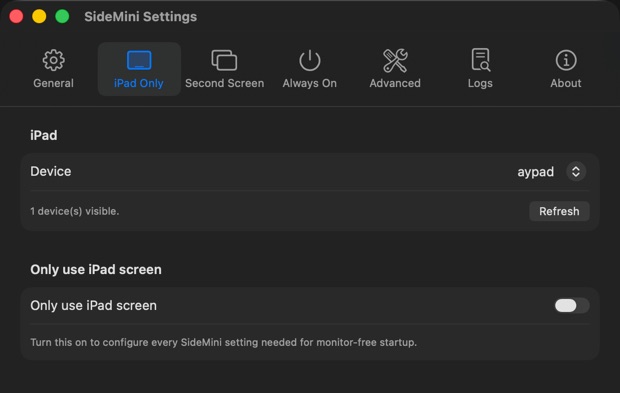
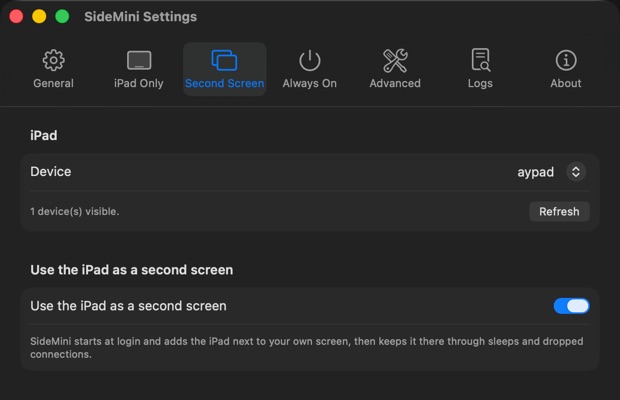
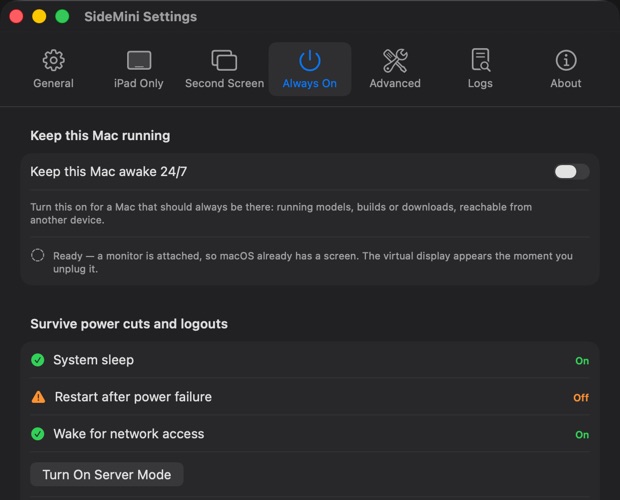
Illustration of a real SideMini log; the tabs are the three setups. Nothing here touches your Mac.
Choose your setup
One small app, three clear jobs.
SideMini was built first for a Mac mini with no monitor. The same automation can also add an iPad beside an existing screen or keep a Mac available as a server.
iPad as the only screen
Primary setupFor a Mac mini or Mac Studio with no monitor. SideMini creates a virtual display, connects the iPad and restores the link whenever it drops.
See the monitor-free setup →iPad as a second screen
MacBook · iMac · Mac miniKeep the screen you already have. SideMini adds the iPad at every login, extended or mirrored, with your chosen resolution.
See the second-screen setup →Always-on Mac server
No iPad requiredKeep a Mac awake, restart after a power cut and give Screen Sharing a sharp virtual display at 1080p, 1440p or 4K.
See the server setup →Why it works
Sidecar needs a screen before it can become one.
A headless Mac has no real framebuffer, so a normal Sidecar connection starts and then disappears. SideMini gives macOS a display first, then hands that display to your iPad.
Set up once
Three steps. The first two happen once.
Keep a monitor attached for the initial setup and test. Once the automatic behavior works, the monitor can go.
Install and choose your iPad
The welcome guide checks Sidecar, Wi‑Fi, Bluetooth and your Apple Account, then runs a test connection.
OnceTurn on iPad Only
One switch enables start-at-login, automatic connection and reconnect. Startup security remains your decision.
OnceUnplug the monitor
Restart, wake or reconnect. SideMini waits for the iPad and restores the display without Control Center.
AutomaticThe useful six
Everything needed for the connection to stay boring.
The uncommon controls remain available in Settings. These are the features that matter every day.
Starts at login
Connects as early as macOS allows, without opening Control Center.
Waits for the iPad
If the iPad is asleep, SideMini retries in bursts and connects when it becomes reachable.
Reconnects after drops
The first retry fires in about two seconds, then backs off and keeps watching.
Remembers the display
Resolution, HiDPI, mirror or extend are reapplied to every connection.
Replaces a dummy plug
A local virtual display gives Screen Sharing a sharp desktop with nothing in a port.
No account or tracking
Activation and revocation use one-way license identifiers. No analytics, usage data or crash reports leave the app.
The app itself
A tab per setup, a switch per tab.
Everything lives in the menu bar and one settings window. The switch at the top of each tab configures the whole setup; the details underneath are there when you want them and ignorable when you do not.
Before you download
What you need, and the honest trade-off.
The trial is the right place to test the complete boot with your own Mac and iPad.
What you need
- macOS 14 Sonoma or later and a Sidecar-compatible iPad.
- The same Apple Account with two-factor authentication.
- Wi‑Fi and Bluetooth on; USB is optional and recommended.
- A monitor for the first pairing and restart test.
The startup trade-off
A fully unattended cold boot requires FileVault off and automatic login on, because no app can run before macOS reaches the desktop. Prefer encryption? Keep FileVault and use the documented planned-restart or blind-login options.
Understand the FileVault choices →Good to know
SideMini is signed and notarized, but it cannot be distributed through the Mac App Store. It uses private Sidecar interfaces that Apple may change in a major macOS update.
Why it ships outside the App Store →Try the real setup
Three days free. Then $9 once.
The trial is the full app in all three setups. No card, no account and nothing to cancel. Test a real restart before you buy.
macOS 14 or later · signed and notarized
- All three setups
- Every 1.x update
- Two Macs you own
- Five-day refund if it does not fit your setup
Five useful answers
Before you rely on it.
More specific fixes live in Help.
Does it work with no monitor attached?
Yes. That is the primary setup. SideMini creates a virtual display before connecting the iPad, then removes it when a real monitor returns.
What if the iPad is asleep at boot?
SideMini retries in short bursts and then watches quietly. Wake the iPad and the connection resumes within seconds.
Do I have to turn off FileVault?
Only for a completely unattended cold boot. Planned restarts and manual blind login let you keep FileVault on.
Does the app send any data?
There is no account, analytics, crash reporting or usage tracking. Activation registers one-way license and device identifiers; a one-way license identifier is checked periodically for revocation. The app keeps working when offline. See the privacy policy.
Could a macOS update break Sidecar automation?
Yes. SideMini uses private Sidecar interfaces that Apple can change. The app reports the problem instead of failing silently, and fixes ship as free 1.x updates.
Start with your situation
Three practical guides.
The full library is grouped by Sidecar, headless Mac and server topics.
How to use a Mac mini without a monitor
Screen Sharing, SSH, dummy plugs, an iPad and what breaks before login.
Read the guide → SidecarUse an iPad as a second monitor
Extend or mirror, cable or wireless, and how to make Sidecar reconnect itself.
Read the guide → Server & local AITurn a Mac into an always-on LLM server
Keep Ollama or LM Studio awake, reachable and usable without a monitor.
Read the guide →